Download PDF The Generalissimo's Son: Chiang Ching-kuo and the Revolutions in China and Taiwan By Jay Taylor
The factor of why you can receive as well as get this The Generalissimo's Son: Chiang Ching-kuo And The Revolutions In China And Taiwan By Jay Taylor earlier is that this is the book in soft file type. You can review the books The Generalissimo's Son: Chiang Ching-kuo And The Revolutions In China And Taiwan By Jay Taylor any place you want even you are in the bus, office, home, and also various other locations. But, you could not need to relocate or bring the book The Generalissimo's Son: Chiang Ching-kuo And The Revolutions In China And Taiwan By Jay Taylor print any place you go. So, you won't have bigger bag to lug. This is why your choice to make better concept of reading The Generalissimo's Son: Chiang Ching-kuo And The Revolutions In China And Taiwan By Jay Taylor is really handy from this case.
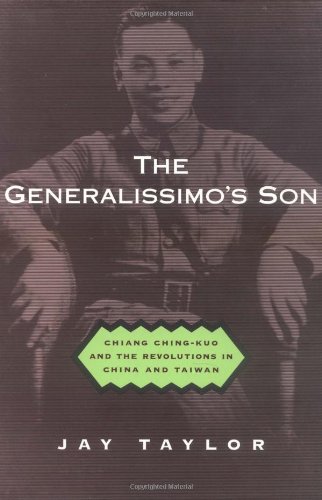
The Generalissimo's Son: Chiang Ching-kuo and the Revolutions in China and Taiwan By Jay Taylor

Download PDF The Generalissimo's Son: Chiang Ching-kuo and the Revolutions in China and Taiwan By Jay Taylor
Do you believe that The Generalissimo's Son: Chiang Ching-kuo And The Revolutions In China And Taiwan By Jay Taylor is an excellent publication? Yes, we assume so, looking as well as knowing who the author of this publication; we will definitely understand that it is a great book to check out every time. The author of this publication is popular in this topic. When somebody needs the recommendation from the subject, they will certainly seek for the details as well as information from the books composed by this writer.
Reading will certainly not offer you many points. Yet, checking out will certainly offer just what you require. Every publication has certain topic and also lesson to take. It will certainly make everybody desire to choose what book they will certainly read. It makes the lesson to take will truly associate with exactly how the person requires. In this situation, the presence of this site will actually help visitors to discover numerous books. So, really, there is not just the The Generalissimo's Son: Chiang Ching-kuo And The Revolutions In China And Taiwan By Jay Taylor, there are still lots of sort of the books to collect.
This book will certainly be constantly most desired due to the fact that the topic to increase is incredibly popular. Besides, it includes the topic for every age and condition. All degrees of individuals rate very well to read this book. The advance of this book is that you could not have to feel tough to recognize what this publication deal. The lesson, expertise, experience, and also all points that might supply will certainly need your life time to really feel better.
After obtaining the soft data, you could easily create brand-new ideas in your mind. It is hard to get the book in your city, most likely furthermore by checking out the shop. Checking out the shop will not also give warranty to obtain the book? So, why do not you take The Generalissimo's Son: Chiang Ching-kuo And The Revolutions In China And Taiwan By Jay Taylor in this site? Even that's just the soft documents; you can truly feel that guide will certainly be so valuable for you and life around.
- Sales Rank: #935967 in Books
- Brand: Brand: Harvard University Press
- Published on: 2000-10-15
- Released on: 2000-09-27
- Original language: English
- Number of items: 1
- Dimensions: 9.52" h x 1.33" w x 6.55" l, 1.95 pounds
- Binding: Hardcover
- 544 pages
- Used Book in Good Condition
From Publishers Weekly
Taiwan enjoys a booming economy and a lively, boisterous democracy. In this deeply detailed biography, Taylor maintains that Chiang Ching-kuo is largely responsible for both. Though historically still in the shadow of his famous father, Chiang Kai-shek, whose Nationalist party lost China to the Communists in 1949 and who then fled to Taiwan, the younger Chiang spent a life that is itself fascinating. Born in 1910, as China was disintegrating into anarchy, Chiang as a young man spent 12 years in the Soviet Union as a student and Soviet Party functionary. Returning to a China in chaos, he proved himself a capable administrator amid the otherwise corrupt Nationalists. In exile in Taiwan, he gained immense power, especially after the death of the elder Chiang in 1975. According to the author (a former Asia specialist with the U.S. Foreign Service), he used this power for bad and good. As head of numerous secret agencies, Chiang helped keep Taiwan a brutal dictatorship for 30 years. Yet he was prescient enough to draw into the government skilled personnel who laid the groundwork for the island's spectacular economic development, and pragmatic enough in the years before his death in 1988 to see that a transition to democracy was necessary and inevitable. Of special note is Taylor's account of how Chiang skillfully read and used the changing trends of the Cold War and the post-Cold War period to allow Taiwan to not only survive but prosper. Whether the good Chiang did outweigh the bad remains an open question, but he clearly was a leader of importance. This work will long remain his definitive biography, which means that this could remain in print indefinitely, enjoying small but steady sales. (Oct.)
Copyright 2000 Reed Business Information, Inc.
From Library Journal
Taylor, who once served in the U.S. Foreign Service, was asked by the semiofficial China Times Publishing Company in Taipei to write an independent, unrestricted biography of Chiang Ching-kuo, the son of and successor to Generalissimo Chiang Kai-shek (1887-1975). Chiang Ching-kuo witnessed the loss of the mainland to Mao's Communists, having returned to China in 1937 from a decade in the Soviet Union, but eventually he led the building of Taiwan into a thriving commercial society and feisty democracy. Taylor used published sources in English and Chinese but also had unprecedented access to political figures in Taiwan and the People's Republic. Although no biography could settle all the questions regarding this colorful, controversial, and powerful figure, Taylor's strong narrative deals with it in an informed and frank but sympathetic way, addressing such topics as CIA intervention, economic policy, and family affairs. Recommended for both specialist collections and public libraries with depth in international affairs.DCharles W. Hayford, Northwestern Univ., Evanston IL
Copyright 2000 Reed Business Information, Inc.
Review
A breakthrough in information available in English about an important and relatively little-known historical character, about U.S.-Taiwan relations from the 1950s through the 1980s, and about political dictatorship and reform in Taiwan. (Andrew J. Nathan, author of China's Transition)
A well-written account of an extraordinary life, narrated against the background of the world-shaking events in which Chiang Ching-kuo was deeply involved: the Soviet Revolution, the Sino-Japanese war, the civil war between the Nationalists and the Communists in China, and the Cold War. Taylor's book fills a glaring gap in the literature; it will be valued by scholars and by others interested in the character and role of a memorable individual in the making of today's Taiwan. In writing this full-length biography, Taylor has interviewed scores of people who knew Ching-kuo well at various stages of his life. He traveled to his hometown, Hsikou, and to the area that he administered in southern Kiangsi to interview people in both places about Ching-kuo's early life. He has also located documents and interviewed individuals who cast light on Ching-kuo's experience in the Soviet Union. It will be a distinguished addition to Harvard's publications on China. (Ralph N. Clough, Johns Hopkins University)
A readable, and fascinating book--a breakthrough in information available in English about an important and relatively little-known historical character, about U. S.-Taiwan relations from the 1950s through the 1980s, and about political dictatorship and reform in Taiwan. The book paints a large canvas. It gives attention to the man, his family life, and his immediate relationships, but also to the general political setting. The writing is direct and clear. Taylor is good at reimagining circumstances, sometimes because he's visited the scenes and met the people. With his voracious appetite for sources and reliance on interviews, he can often bring a scene to life. Taylor is shrewd and honest at the level of particular incidents and issues, and he writes in a voice of tolerant disillusionment about human folly in general. He creates a plausible, humanly complex sense of the thinking and motivation of characters. (Andrew J. Nathan, author of China's Transition)
Taylor tells the story of Chiang Ching-kuo's life well. The writing is clear and the relationship between Ching-kuo's family and career to the dramatic 'sweep' of the century is maintained throughout. A consistent effort is made--rather successfully--to contrast Ching-kuo's experience with that of his old Moscow classmate, Deng Xiaoping. Taylor offers a significant reinterpretation of Ching-kuo's time in the USSR, leading one to conclude that he may really have meant it in all of those Stalinistically stylized denunciations of his father, or at least in some of them. More important, Taylor makes it clear, even in an understated way, that the time in the USSR was formative, politically, for his subject. (William C. Kirby, Harvard University)
Taiwan enjoys a booming economy and a lively, boisterous democracy. In this deeply detailed biography, Taylor maintains that Chiang Ching-kuo is largely responsible for both. Though historically still in the shadow of his famous father, Chiang Kai-shek...the younger Chiang spent a life that is itself fascinating...Of special note is Taylor's account of how Chiang skillfully read and used the changing trends of the Cold War and the post-Cold War period to allow Taiwan to not only survive but prosper...This work will long remain his definitive biography. (Publishers Weekly)
Most historians have not been kind to the man who failed China and then ruthlessly established his presence on the island of Taiwan, which he ruled under martial law until his death in 1975...Jay Taylor tries to convince us that Chiang Ching-kuo, despite his own ruthless suppression of any opposition in Taiwan, was fundamentally a better man than his father...Following his life in this book gives one a good picture of this tumultuous period in China's history. It may also help to explain at least a little of the passion felt on both sides of the Taiwan Straits. (Danyll Wills South China Morning Post 2000-10-14)
Jay Taylor has written a superb, magnificently researched biography of Chiang Kai-shek's son, Ching-kuo, the man who set the stage for the democratization of Taiwan. [The Generalissimo's Son] tells the fascinating story of the man who set Taiwan on its new course, a course which seems to preclude unification with China and presents a grave danger to the peace of the world. (Warren I. Cohen Times Literary Supplement 2001-04-20)
The first comprehensive Chiang Ching-kuo biography in English, this very readable book is based on extensive documentary research and interviews. It is an important addition to the literature of China's (and Taiwan's) modern history and politics. (J. Chen Choice 2001-07-01)
Taylor has written an excellent biography. (Jonathan Fenby Times Higher Education 2009-07-30)
[A] detailed and revealing biography. (Jonathan D. Spence New York Review of Books 2009-10-22)
Break[s] new ground--introducing a relatively unknown figure to the West. By weaving together numerous interviews and historical research, [Taylor] create[s] a fast-paced narrative that crackle[s] with the excitement of international diplomacy and Cold War espionage. (Robert Green Far Eastern Economic Review 2009-05-01)
The Generalissimo's Son: Chiang Ching-kuo and the Revolutions in China and Taiwan
By Jay Taylor PDF
The Generalissimo's Son: Chiang Ching-kuo and the Revolutions in China and Taiwan
By Jay Taylor EPub
The Generalissimo's Son: Chiang Ching-kuo and the Revolutions in China and Taiwan
By Jay Taylor Doc
The Generalissimo's Son: Chiang Ching-kuo and the Revolutions in China and Taiwan
By Jay Taylor iBooks
The Generalissimo's Son: Chiang Ching-kuo and the Revolutions in China and Taiwan
By Jay Taylor rtf
The Generalissimo's Son: Chiang Ching-kuo and the Revolutions in China and Taiwan
By Jay Taylor Mobipocket
The Generalissimo's Son: Chiang Ching-kuo and the Revolutions in China and Taiwan
By Jay Taylor Kindle