Free Download Grokking Deep Learning
This book is offered in soft documents forms. You could download it. One that will certainly influence you to read this book is that it can be your very own choice to earn far better feels. Your life is your own. And selecting this Grokking Deep Learning as your analysis product is also your choice. But right here, we really advise you to read this book. You could discover just what the variables we present. Simply get this book and review it, so you can acquire the reasons of why you should review.
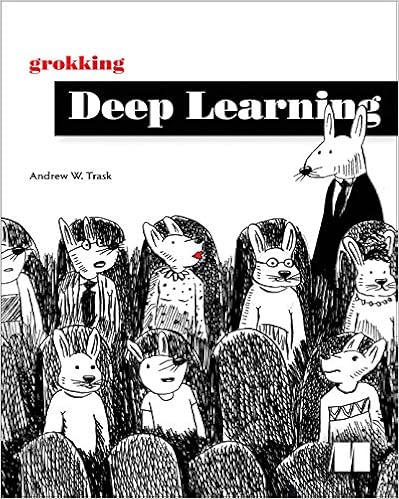
Grokking Deep Learning

Free Download Grokking Deep Learning
Trying to find the brainwave ideas? Need some publications? The amount of books that you need? Here, we will certainly ere among it that can be your brainwave concepts in deserving usage. Grokking Deep Learning is exactly what we indicate. This is not a fashion making you straight rich or wise or amazing. Yet, this is a fashion to always accompany you to always do and improve. Why should be far better? Every person will need to accomplish fantastic progress for their way of life. One that can influence this case is getting the ideas for brainwave from a book.
Really feeling tired after doing some tasks in trips will buy you to have relaxation for some minutes. It will likewise help you to meet the cost time. When you could enjoy your time for leisure as well as neglect the view around you, it is the most effective time to have likewise checking out. Yeah, reading publication becomes a very excellent suggestion to do today. However, do are you feel weird not to bring specific book?
From the book, you will certainly understand that analysis is absolutely had to do. It will direct you to get even more precious spending quality time. By reviewing the books, your spent time will certainly not squander improperly. You could discover exactly what you need and want to observe. Right here, the Grokking Deep Learning comes to be an option to check out the book because it provides you the outstanding functions of the life. Also it is just the rep are for getting this type of publication, you might see exactly how you could take pleasure in guide exactly.
Ease of the language as well as simple works to understand end up being the factors of many people attempt to obtain this book. When you intend to locate even more about Grokking Deep Learning, you can see who the author is, who the individual that has developed guide is. Those will be much more remarkable. Thus, you could visit the web page with the web link that we offer in this article. It will certainly not be so complex for you. It will be a lot easier to acquire.
Product details
Paperback: 336 pages
Publisher: Manning Publications; 1 edition (January 25, 2019)
Language: English
ISBN-10: 1617293709
ISBN-13: 978-1617293702
Product Dimensions:
7.2 x 0.8 x 9.2 inches
Shipping Weight: 1.3 pounds (View shipping rates and policies)
Average Customer Review:
4.2 out of 5 stars
6 customer reviews
Amazon Best Sellers Rank:
#27,426 in Books (See Top 100 in Books)
Just arrived and diving in this week, the first impressions are that this is a deep dive on the mechanisms of Deep learning, but exceptional in the way the material is accessible to those without classical math background. You just need to devote some effort and basic reasoning and you should be plenty out of this book, Bon appetit ! I will update this if my description changes, this study effort will take a few weeks. Peace.
This is a wonderful, plain-English discussion of the mechanics that go on under the hood of neural networks - from data flow to updating of weights. Specifically written without a slant on normally-wonky math, the concepts are presented and then advanced at a digestable pace for anyone. It makes for a wonderful textbook for a course, and should be required reading for product managers or marketing people getting into deep learning, alike.
TL;DRPros: the book helps to grasp basic math concepts that can be used as the foundation for deep learning, gradually increasing their complexity and using lots of simple examples.Cons: some critical code implementations of deep learning networks are wrong and creating misconstrued notions about how they work.Recommendation: not worth the price (~45$ for print book as of Feb 2019), deep networks' code snippets must be treated with suspicion.Full review: This review is done based on first 9 chapters, if anything changes significantly when I'm done with the rest of the book, I will update the review. My first impressions from 'Grokking Deep Learning' were very positive. I can agree with many reviewers here that the book has a very cool concept of starting with some easy and accessible math and gradually building up reader's understanding of deep learning inner workings.However, chapters 8 and 9 were so bad that they marred the whole experience for me. In these chapters the readers were supposed to take their first steps beyond simplest neural networks and learn about dropout and batching (chapter 8), as well as some other activation functions(chapter 9). The problem is that code snippets that were supposed to introduce these concepts contained some serious mistakes. Those were not just typos or leaked draft versions - every tech book contains some amount of those. I'm rather talking about implementation errors that could distort reader's comprehension of why and how enhancements to basic neural networks could and should be made. It seems that even the text flow in those chapters was affected by implementation flaws, even further confusing a reader. To substantiate these claims, I collected some examples. Chapter 8. 1. The very first code snippet is a simple network that learns from MNIST dataset how to decipher handwritten digits. Its test accuracy is ~70% at iteration 349, and this low number is supposed to show how easily neural network overfits. The real problem though is that this low test accuracy is the result of incorrect implementation of the 'relu2deriv' function that is used in backpropagation. With the fixed function, test accuracy of the same network reaches ~82%. Overfitting is still there, but 82% for fairly simple example is not that bad. Unfortunately all other examples in chapter 8 and 9 that use relu and relu2deriv functions use the same erroneous implementation and are not valid. 2. To reduce overfitting dropout technique is applied. While high level arguments in the books are clear and valid, dropout implementation is problematic on several levels. First of all, dropout example is incomparable to non-dropout one since they have different layout - the hidden layer size was increased from 40 to 100 nodes and iteration count was decreased from 350 to 300. Moreover, the last logged iteration now is 290 instead of 349. For some reason, these changes were not announced in the text. Secondly, even if we compare two performances, the boost of ~10% that a reader can see should be explained as the result of incorrect implementation of 'relu2deriv'. Despite of what text is saying, dropout in this example is just trying to curb effects of that mistake. If you implement relu2deriv correctly, set up hidden layer nodes count to 100 and iterations to 290, you will not see much difference between non-dropout (88.88% peak test accuracy, 87.6% final test accuracy) and dropout versions (88.09% and 87.34% respectively). So either a reader will be misguided by the book's examples to think that dropout gives an enormous boost, or disillusioned, s/he will be left wondering and searching elsewhere what dropout real efficiency is and if this implementation is correct. 3. Batch example is just plain wrong. The book says that batched network will be updating weights once per batch, but the implementation keeps updating it with each row of input data. What is really perplexing is that the network wouldn't work with such loop logic. Instead of doing the right thing and fixing the latter, the code divides values of layer_2_delta by batch size. And still neither accuracy nor speed are improved. If we implement it correctly with the proper looping logic and proper 'relu2deriv' implementation, we will not get much improvements for test accuracy, but training will be done much faster. 4. So bottom line is that all improvements in chapter 8 were done just to battle the 'original sin' - incorrect 'relu2deriv' function. With this function fixed and increased number of nodes in the hidden layer, the very fist simple network with relu activation function will perform as good as the network with dropout and batching. The only gain was in speed, and only with the properly implemented batching logic. Of course, all this says nothing about how good dropout is or what the real power of batching is - a reader must go and find the answers in some other sources. Chapter 9. The biggest part of the chapter is the explanation of how different activation functions can be used in different contexts for greater accuracy. While on theoretical level everything looks valid, code implementation is again misleading. 1. The same as in chapter 8, it uses a divisor when calculating layer_2_delta. While in chapter 8 it was necessary because of the incorrect loop implementation, here it is absolutely uncalled for. The loop this time is correct, but divisor is actually became larger since now it's a product of batch size and layer_2.shape[0], or 100*100 = 10000. Why? No explanation. Also, alpha is set up unusually high as 2. So, in order to fix that, one has to get rid of the divisor and divide alpha by the same value of 10000. Test accuracy will not change (0.8701 at iteration 290), but the network logic will not be dependent on batch size anymore. 2. Still, whether's it's the book's version or the fixed one, accuracy doesn't go above 87%. It's still less than 88% of 'plain vanilla' relu example, granted that relu2deriv is implemented properly and hidden nodes count is 100. So all the improvements were in vain - and yes, I realize that test accuracy is not the only parameter to look at. But in the book it's a decisive one, and there's no gain in it from more complex tanh/softmax example. 3. Just out of curiosity I tried to use properly implemented relu/relu2deriv functions in the fixed example, while keeping softmax function in place. This is first time we can see any gain in accuracy. It centers around 89% which is 1% gain to plain vanilla version. Well, it seems that softmax can help. Is it just 1%, or could be it be more? What about tanh? Why it didn't show any gain in accuracy compared to relu? Is it because we implemented it wrong? Is it because the context is not right? Maybe, parameters set up was wrong - alpha, hidden layers/nodes etc? Again, we have to look for answers elsewhere. It's the same outcome that I had with chapter 8. Conclusion After first 7 chapters I would gladly recommend this book to everyone interested in learning about deep networks from scratch. After chapter 8 and 9 I'm not so positive about it. If you like forensic analysis - maybe. If the trust to what you read is a must - probably, the book is not for you. Anyway, I think that the price isn't justifiable. This book needed a good technical editor and/or reviewer, perhaps it could become a real gem. If you see it on 50% sale at Manning or Amazon and you feel adventurous - go for it. If not - go elsewhere.
What is the book about?- This book is about teaching you everything you need to know about Deep Learning in greater detail. The author will teach you how to write Deep Learning algorithms from scratch.Who is this book for?- For everyone who want to learn everything about Deep Learning from scratch.What I loved- The book simplifyes deep learning a lot. It gives you great insight into how Deep Learning learns and why it works.- The book starts very small and builds up your knowledge in greater detail, chapter after chapter. It will teach you how to write your Deep Learning algorithms better through each chapter while answering questions surrounding the algorithms you face a long the way.What could be improved- Chapter 10 teaches you how to write a program that identify symbols/numbers from images. The chapter is too short and does not describe the code in greater detail. It would be better if the author could write a bit more to save the reader a lot of time figuring out Convolutional Neural Networks algorithms from scratch. However, the knowledge learned from the book will give you an advantage to figure this out in the end.Round Up- If you want to start with Deep Learning, this is the perfect introduction.This book gives you a solid and important foundation to fully understand and build your own Deep Learning algorithms and frameworks using only Python.- The best way to learn Deep Learning is by writing the algorithms by hand. This book is an excellent choice to do just that.- The book was extremely exciting and fun.- The book have made it easier to fully understand the deep learning frameworks that are available today.- Thanks to this book, Deep Learning is not a black box anymore.
Excellent book, I really like the analogies that you made in order to explain some complex concepts
The author does an excellent job of gently taking the reader through a series of learning exercises, steadily building-up a deeper understanding and a broader view of Deep Learning.
Grokking Deep Learning PDF
Grokking Deep Learning EPub
Grokking Deep Learning Doc
Grokking Deep Learning iBooks
Grokking Deep Learning rtf
Grokking Deep Learning Mobipocket
Grokking Deep Learning Kindle